Person A
Dizziness
You notice it most when:
- Walking through busy stores
- Watching traffic or moving objects
- Scrolling on your phone or watching fast-moving screens
Our approach
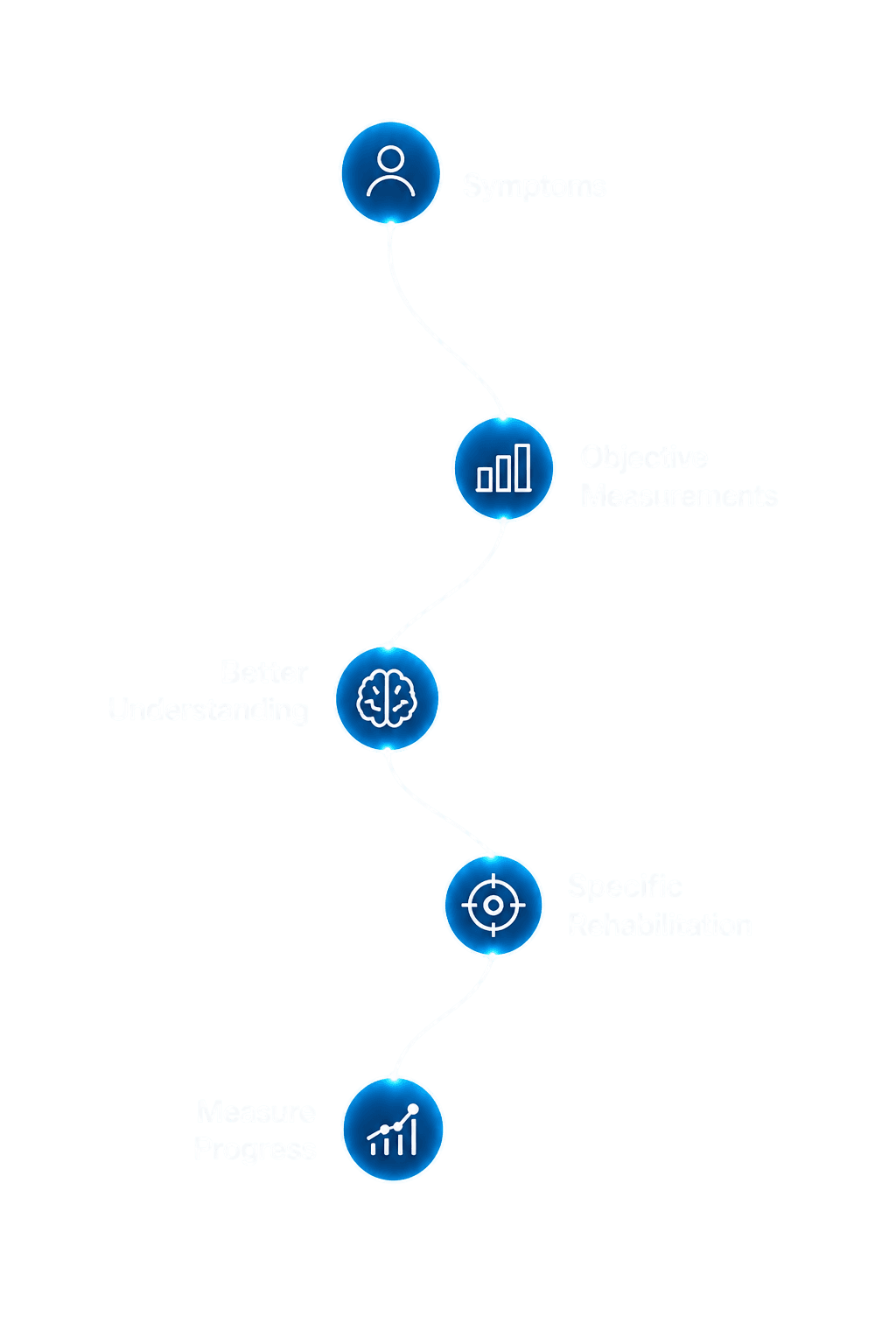
Persistent symptoms can come from many different areas of the nervous system. Instead of beginning with a predetermined protocol, we first work to better understand how your system is functioning. Those objective measurements help us better understand how your nervous system is functioning. That understanding guides rehabilitation that is more specific to you.
Understanding the pattern
Two people can experience the same symptom while having very different underlying patterns.
One person notices their symptoms most in busy stores, around moving traffic, or while watching screens. Another notices their symptoms most when closing their eyes, walking in the dark, or standing on uneven ground.
That is why symptoms alone do not always tell us what rehabilitation should look like.
Same symptom. Different pattern.
Person A
Dizziness
You notice it most when:
Person B
Dizziness
You notice it most when:
The same symptom does not always require the same rehabilitation.
Illustrative examples, not diagnoses.
Understanding through measurement
Two people may describe the same symptoms while their nervous systems function very differently.
Objective assessment helps us identify those differences so your rehabilitation can be more specific to you.
Instead of relying only on symptom descriptions, we look for measurable patterns that help explain how your nervous system is functioning.
Can help explain why the world feels unstable, blurry, or difficult to focus on.
Can help explain why you feel unsteady, especially when standing or walking.
Can help explain why busy stores, scrolling, or moving environments make you feel worse.
Can help explain why movements feel awkward, inconsistent, or require more effort.
Can help explain dizziness, poor balance, and difficulty knowing where your body is in space.
Can help confirm whether rehabilitation is improving how your nervous system functions over time.
Individualized rehabilitation
Once we understand what is contributing to your symptoms, we begin learning how your nervous system responds best to rehabilitation.
Some people improve with one approach. Others improve faster with a completely different approach, even when their findings look similar.
The goal isn't just to identify what needs improvement. It's to understand how your nervous system responds best so your rehabilitation can become as specific as possible.
Step 1
Objective measurements identify what may be contributing to your symptoms.
Step 2
We observe how your nervous system responds to different rehabilitation strategies.
Step 3
Exercises are selected and progressed based on both your findings and your response.
Step 4
Objective reassessment helps us track improvement and guide what comes next.
Objective reassessment
Feeling better is important, but it's only part of the picture.
Throughout rehabilitation we repeat the same objective assessments used during your initial evaluation. This allows us to compare your results over time instead of relying only on questionnaires or symptom reports.
Those repeated measurements help us objectively determine what is improving, what still needs attention, and how your rehabilitation should continue to evolve.
Progress is measured, not assumed.
Initial Assessment
Objective Measurements
Rehabilitation
Repeat Assessment
Compare Results
Refine the Plan
Understanding your experience
Persistent neurological symptoms often feel unpredictable and confusing.
When you don't understand what your nervous system is doing, rehabilitation can feel like a guessing game.
Understanding your objective assessments can reduce that uncertainty. When you can connect your symptoms to what the measurements show, the path forward becomes clearer.
Every exercise has a specific purpose. You should understand why you're doing it, what it's designed to improve, and how it connects to the symptoms you've been experiencing.
Rehabilitation is something you participate in, not something you simply receive.
The more you understand what your nervous system is doing, the more meaningful rehabilitation becomes.
How Each Session Is Personalized
Initial Measurements
Objective assessments identify today's pattern.
Targeted Intervention
A specific intervention is selected based on today's objective findings.
Immediate Retesting
Objective measurements are repeated immediately after each intervention to determine how your nervous system responds.
Refine Treatment
The next intervention is guided by your objective response. This process continues throughout the visit as your nervous system responds.
Home Program
The interventions that produce the strongest objective response become the foundation of your home program.
You don't need all the answers before your first visit. That's what the evaluation is for. Together we'll work to better understand what's contributing to your symptoms and determine whether our approach is the right fit for you.